

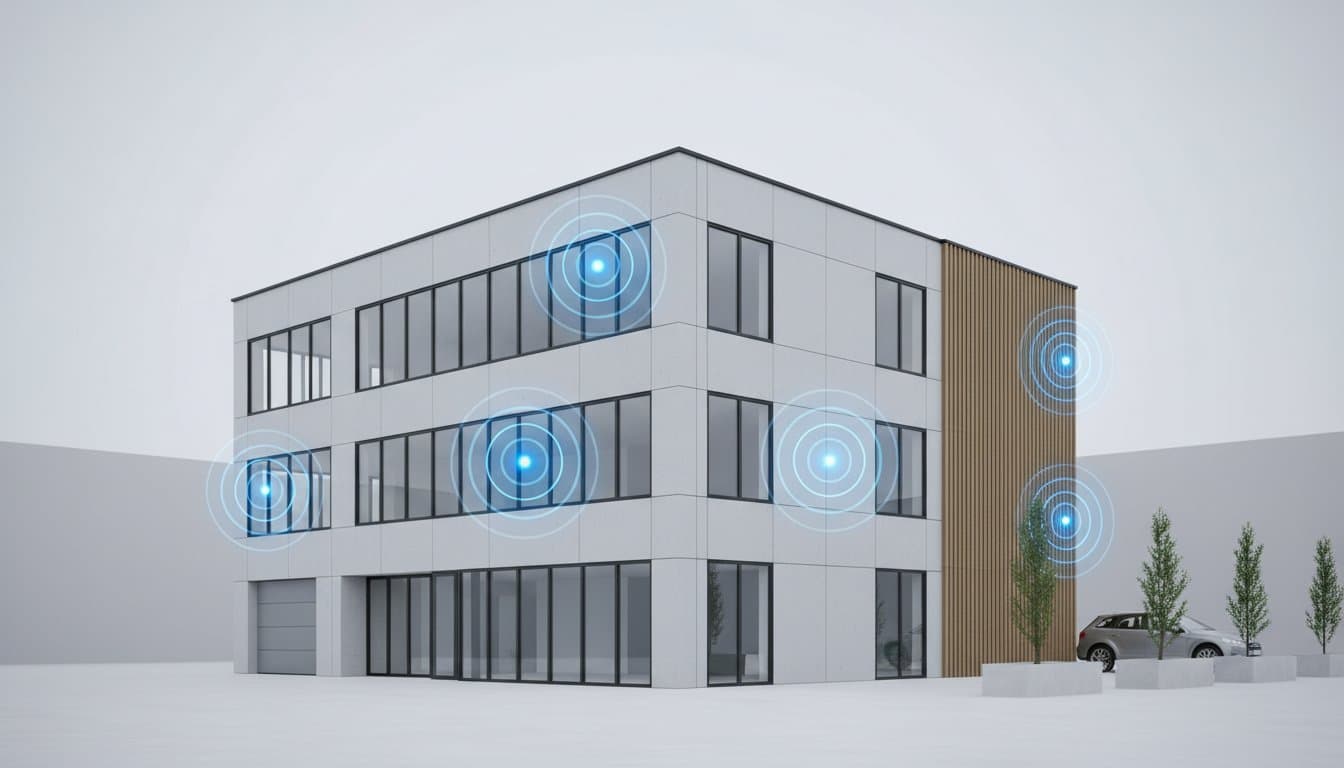
In many buildings, ambitious energy goals come to a halt for one practical reason: infrastructure.
Traditional energy metering often requires cabling between meters and central systems. In new builds, this is manageable. However, in existing building stock—which makes up the majority of buildings in Europe—it can be costly, time-consuming, and in some cases, physically impractical.
This is where LoRaWAN emerges as a viable alternative.
When Cabling Becomes a Barrier
When retrofitting existing buildings, the same challenges often arise:
- Technical rooms are not designed for modern metering infrastructure.
- Cable routing requires interventions in walls, floors, or historically protected structures.
- The cost per metering point becomes disproportionately high.
- Projects stall before they even get started.
The result is that many buildings still lack detailed insight into their energy consumption—despite growing demands for both sustainability and cost control.
A Wireless Approach
LoRaWAN (Long Range Wide Area Network) is a wireless communication technology designed to send small amounts of data over long distances with very low power consumption.
For energy metering, this means in practice:
- Power meters and sensors can transmit data wirelessly.
- A single gateway (antenna) can cover a large area—often an entire city district.
- Installation is done without extensive cabling.
- Existing buildings can be upgraded without major physical interventions.
This significantly lowers the barrier to establishing a modern metering system.
From “Impossible” to Feasible
What previously required extensive planning and installation can now, in many cases, be achieved with relatively simple steps.
A typical LoRaWAN-based installation means that:
- Metering points are installed where the energy is actually consumed.
- Data is continuously sent to a central platform.
- The system can be scaled gradually, without needing a full rollout from day one.
This makes it possible to start small and expand as needed—a crucial factor in existing buildings with limited budgets.
Example: 2020park
A concrete example of this approach can be found in the 2020park project.
Here, a former brewery was transformed into a modern shopping center, with high standards for both sustainability and energy efficiency. Instead of relying on traditional, cable-heavy infrastructure, a solution was chosen that enabled flexible and scalable collection of energy data.
By combining wireless metering with a platform for analysis and cost allocation, they achieved:
- Detailed insight into energy use across tenants.
- Automated and precise billing.
- A better foundation for energy efficiency improvements.
The project illustrates how existing buildings can be brought up to modern standards without starting from scratch.
More Than Just Data
The key takeaway is not the technology itself, but what it enables.
When the barrier to collecting energy data is lowered, it opens the door to:
- Correct allocation of energy costs.
- Identification of unnecessary consumption.
- A better basis for decision-making on improvement measures.
- Documentation of sustainability initiatives.
In other words: data only becomes valuable when it is actually available.
A Shift in How We Think About Retrofitting
LoRaWAN represents not just a technical solution, but a shift in how we can approach the modernization of buildings.
Instead of asking, “do we have the necessary infrastructure?”, one can increasingly ask:
“what insights do we need—and how can we obtain them in the most efficient way?”
For many buildings, this means the path to better energy control is shorter than previously thought.